A young girl sweeps fallen debris from a tempest that blew through her village of Katra Sahadatganj one recent evening. This remote spot in Uttar Pradesh — India's largest state — has become the center of another gathering storm
It was here two weeks ago where two young girls were audaciously attacked: raped and hanged from a tree. Inter-caste violence and patriarchal attitudes combined to make a chilling spectacle in this impoverished place of mud-caked children and hand-pumped water. But the deaths conceivably could have been averted if the girls had had access to a toilet at home. Lacking one, on the night they were killed, the two teens did what hundreds of millions of women do across India each day: Under the cloak of darkness before sunrise or after sunset, they set out for an open field to relieve themselves.
UNICEF estimates that almost 594 million —nearly 50 percent of India’s population — defecates in the open, with the situation particularly acute in impoverished rural areas such as the Badaun district of Uttar Pradesh. Carolyne Wheeler of the non-governmental organisation WaterAid, which has carried out research on the issue in Uttar Pradesh, said around a third of women have no other option but to relieve themselves after the sun sets — usually accompanied by a friend who keeps watch in case of trouble.
.jpg/220px-Drain%3F_Or_Toilet%3F_(3683494818).jpg)
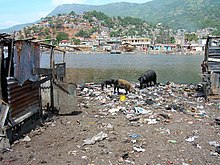
The health and personal safety impacts due to open defecation are principally the same as those from lack of sanitation. Those countries where open defecation is most widely practised have the highest numbers of deaths of children under the age of five, as well as high levels of undernutrition (leading to stunted growth in children), high levels of poverty and large disparities between the rich and poor.
Research from India has shown that detrimental health impacts (particularly for early life health) are even more significant from open defecation when the population density is high: "The same amount of open defecation is twice as bad in a place with a high population density average like India versus a low population density average like sub-Saharan Africa.
There are also strong gender impacts: lack of safe, private toilets makes women and girls vulnerable to violence and is an impediment to girls’ education. Rapes and sexual molestation are taking place when women are searching for places for open defecation that are secluded and private, often during hours of darkness
There can be many reasons why a person is openly defecating and these may include:
1. Lack of other choices, i.e. no toilet available
2. Toilets are available but are filthy, dark, smelly, unattractive (often the case for shared or public toilets)
3. Toilets available but there is a risk of personal safety, e.g. if the toilets are public or shared and criminals are known to gather at those toilets to wait for possible victims
4. Toilets not available as part of the household but only at some distance and it may be dangerous to get there at night
5. Diarrhoea attack may mean there is not enough time to make the way to the shared toilet which may be at some distance
6. Cultural or habitual preference for going to the toilet "in the open air"; Using a local river or stream, or even the bush, may feel better than using a hole in the ground that smells or has flies and lacks light.
Therefore the reasons for open defecation are varied and it can indeed be a voluntary choice but in most cases it is due to the fact that the alternatives (i.e. toilets) are not available or not attractive.
When Prime Minister Narendra Modi, in his Independence Day speech, vowed to eliminate open defecation, India took notice. After all, it was unusual for a prime minister to use the bully pulpit in India to exhort people to end this appalling practice and build more toilets. A staggering 70% of Indians living in villages - or some 550 million people - defecate in the open. Even 13% of urban households do so. Open defecation continues to be high despite decades of sustained economic growth - and despite the obvious and glaring health hazards.
The situation is so bad that open defecation is more common in India than in that are poorer countries such as Bangladesh, Kenya, Democratic Republic of Congo, Malawi, Burundi and Rwanda.
Mr Modi has announced plans to build more than 100 million toilets in the country to end a shameful practice. But many believe the money will not be well spent unless it's accompanied by a massive awareness campaign, involving the government, non-profit groups and citizens.
Now the good news is Domex (http://www.domex.in/) initiates a new program for development of toilets in India,
About The Domex Toilet Academy
Domex, HUL’s flagship sanitation brand, currently runs the Domex Toilet Academy (DTA) programme. Domex Toilet Academy was launched on 19th November 2013. It aims to become a sustainable and long-term solution to provide sanitation that benefits the local community and helps stimulate the local economy. The Toilet Academy makes toilets accessible and affordable, while promoting the benefits of clean toilets & good hygiene. Our effort has resulted in bringing the change in the villages of Maharashtra and Orissa and we aim to build 24000 toilets by 2015 in rural areas faced with the problem of open defecation.
You can bring about the change in the lives of millions of kids, thereby showing your support for the Domex Initiative. All you need to do is “click” on the “Contribute Tab” on www.domex.in and Domex will contribute Rs.5 on your behalf to eradicate open defecation, thereby helping kids like Babli live a dignified life.
End of all I want to say, “Use toilets and stay healthy and safe”.

No comments:
Post a Comment